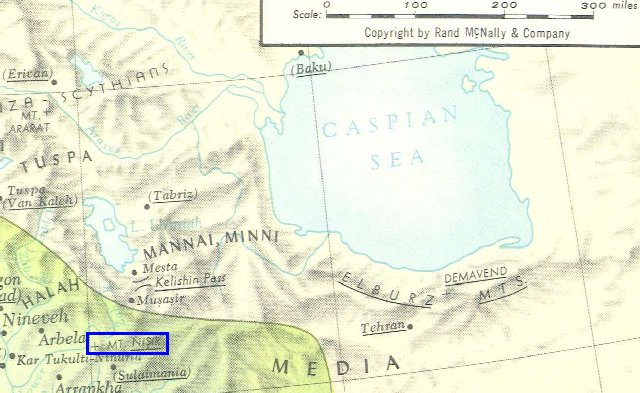
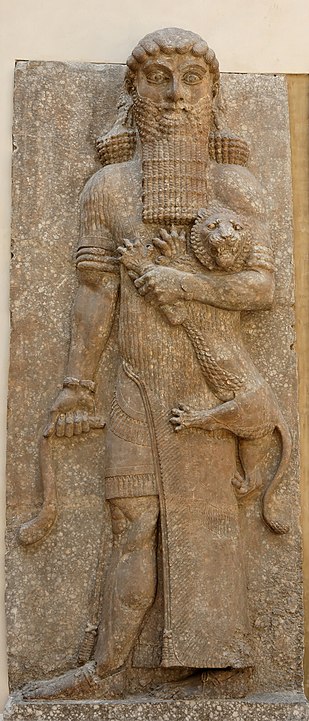
 possibly representing the hero Gilgamesh dominating a lion. It is a relief found in the throne room of the Palace of Sargon II, in present day Khorsabad, N. Iraq, 713–706 BC. Vast collections of clay tablets have been found in Mesopotamia (present-day Iraq), inscribed with texts recording everything from the simplest counting of sheep to the most arcane divination ritual. Many signs refer to everyday and administrative matters (eg product records, religious-divination rituals, etc.), but there are also several that are characterized as literary, i.e. they refer to stories, myths and legends that were texts very widespread in antiquity. Texts similar to the Homeric epics, but older. In the mid-19th century, the Akkadian language, the language in which most of the tablets were written, was deciphered. Since then, the reading of these texts and their various translations began. The largest literary text discovered so far is the Epic of Gilgamesh, an epic poem inscribed on clay tablets in cuneiform in the Akkadian language. Most of the twelve chapters (tablets) of the Epic were found in the royal library of Assurbanipal 1 and in the ruins of the temple of the god Nabu 2, both at Nineveh, Assyria (present-day N. Iraq). We know today for certain that Gilgamesh was a historical figure and that in ancient times he was considered a historical character and not a mythical one. This results from the inscriptions with the "Sumerian King lists" found in archaeological excavations, dated to the period 2500 - 2800 BC. According to the above inscriptions Gilgamesh was king of the city of Uruk (note: it has been identified as modern Warka in central Iraq) during the first dynasty (around 2600 BC). His most important achievement was the building of the walls around Uruk, mentioned in the Epic and confirmed by a younger ruler of the city, Anam, who recorded his own reconstruction of the walls which he referred to as "the ancient work of Gilgamesh". In the "Sumerian king list" Gilgamesh is listed as the fifth king in a row to reign at Uruk after the great flood. Excavations in the city of Warka (formerly Uruk) carried out by German archaeologists in 1928-29 showed a magnificent temple architecture that existed even before the inhabitants of these parts learned writing. Of the approximately 3000 verses of the Akkadian version of the epic, I present below the texts in tablets 9 (IX), 10 (X) and 11 (XI). The first two are related to the journey of the hero Gilgamesh (and king of Uruk) in search of eternal life (immortality), a search that leads him to the hero Ut-napishtim who has survived a great flood, lives with his wife in a heavenly island of the ocean (a country called Dilmun) and had already acquired immortality. Tablet XI relates to Ut-napishtim's description of the flood. I HAVE removed all the repeats in the dialogs that are exclusive to the signs. 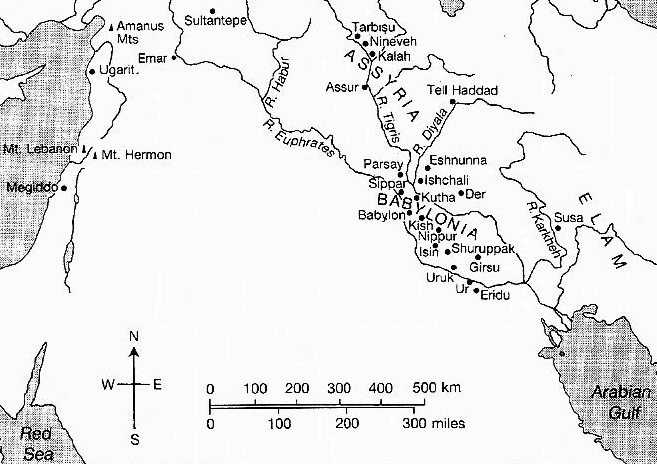 found are shown. Uruk (modern Warka) is in the lower part next to the Euphrates river. [1] About the library of the Assyrian king Assurbanipal [2] A leading Semitic god of writing and wisdom worshiped in the Assyrians and Babylonians. In the Bible it is referred to as Nebo |
|||
|
The clay Tablets IX and X of the Epic of Gilgamesh, called "the quest for eternal life" show a distraught Gilgamesh wandering in foreign lands before and after the Ocean, terrified and saddened by the death of his beloved friend Enkidu, who he considered his brother. Gilgamesh, after the death of his friend, fearing the imminent arrival of his own death, decides to leave the homeland where he reigns, Uruk (in Babylonian Sumeria), and go to see Utnapishtim, who together with his wife were the sole survivors of the cataclysm and the only one who knows the secrets of eternal life. Gilgamesh, after weeping bitterly for his friend Enkidu, wandered the wilderness like a hunter, roaming all the plains. Mourning the death of his beloved friend, he cried:
And so Gilgamesh roamed the deserts, walked green lands, and went on a long journey in search of Utnapishtim, whom the gods had taken after the deluge and settled in the land of Dilmun, in the gardens of the sun. And here they gave him eternal life. His journey overland was perilous: lions lurked, while the passes of the towering Masu mountains were guarded by scorpion-men whose: "Whose aura is frightful, and whose glance is death. At first Gilgamesh's reception is hostile, but as can be seen from a very damaged piece of the tablet, he manages to convince the scorpion-man and his wife that he must pass through their gate, even though the scorpion-man prevents him telling him: Gilgamesh, a mere mortal was not found to accomplish this But Gilgamesh advances through the darkness of Mount Masu:
After traversing the dark passages of Mount Masu, broken, hungry and despoiled, clad in animal skins, Gilgamesh reaches the sea and meets the seer Siduri, the woman who made wine and who sat in the garden by the sea with the gold cups and golden jars that the "gods" gave them. Gilgamesh said to her:
And Siduri, who makes the wine, said to him:
When Gilgamesh heard this he became angry. He took up an axe to his side, Drew the sword from his belt, and ran like an arrow across the sea. In his anger he broke the stones, entered the forest and sat down Stole up and drove them off, like an arrow he fell among them. Immediately Gilgamesh set out and found Urshanabi.
When Gilgamesh heard this, he went to the forest and cut poles, one hundred and twenty in number. And he cut them sixty cubits long. He painted them with tar, put a wreath on them and took them to Urshanabi in the ship. Gilgamesh and Urshanabi together invested the ship with them.
And so Ur-shanabi, the ferryman, carried Gilgamesh to Ut-napishtim, who was also called "Far Away", who lived in Dilmun, in the land where the sun passes east of the mountain. Only to him, of all people, did the gods grant eternal life. |
|
Tablet XI (the so-called flood tablet) begins with Gilgamesh wondering how it is that he and Utnapishtim look exactly alike when one is mortal and the other immortal. Ut-napishtim reveals to him the "secret of the gods" and tells him the story of the flood and how he was saved, and for anyone who knows the story of Noah's ark the similarities are too many. The account of the deluge in the eleventh tablet begins with a council of the gods. 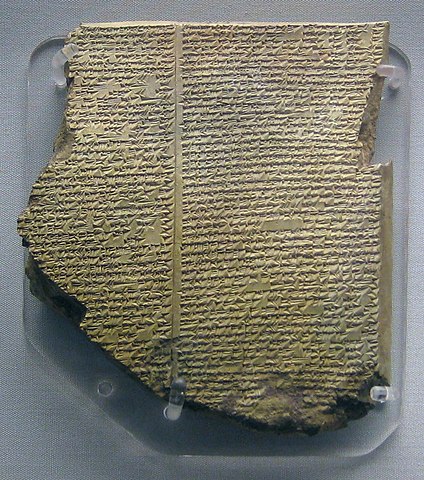 Story of the Flood. From the Library of Ashurbanipal, 7th century BC. It is now in the British Museum The gods decide to send a great flood on the people:Ut-napishtim spoke to him, to Gilgamesh:
Only Ea violates the agreement and warns Utnapishtim of the impending doom, sending a message through a thatched hut and a brick wall. Utnapishtim continues his narration to Gilgamesh:
The construction of the Ark of Ut-napishtimThen, Ut-napisthim builds the big boat (Ark), according to exact instructions and throws it into the water. He tells Gilgamesh how:
The terrible flood is coming:
Ut-napishtim sends out first a dove and then a swallow. Both go back. Finally he sends a raven that does not turn back, a sign that the waters have receded (in the Bible Noah first sends a raven and then two doves), then he makes a great sacrifice to the gods. The gods gathered around the sacrifice. Enlil saw my ship, became angry, raged and quarreled with the gods who dwell in the sky because mortals escaped the destruction. No one should!!! And Ea opened his mouth and said to warlike Enlil:
Enlil is finally convinced and makes Utnapishtim and his wife immortal and sends them to live far away in the land of Dilmun, in the gardens of the sun, where Gilgamesh met him, saying:
And so the Gods took me and placed me here, to live far away at the mouths of rivers.
|
 |
The Greek myth of the Deucalion's deluge |
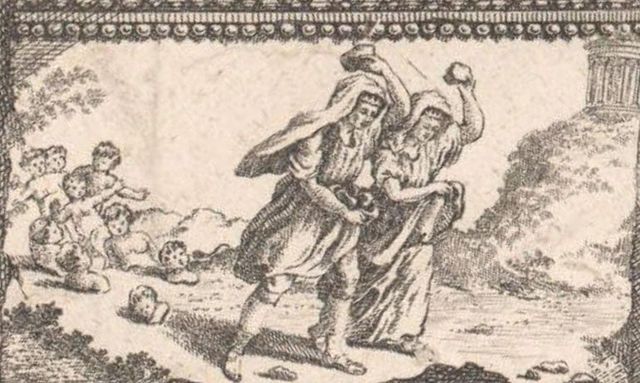
One time people had become so bad that Zeus decided to destroy them with a cataclysm. Then Titan Prometheus, Atlas's brother, advised his son Deucalion to build an ark so as to save himself. Deucalion made an ark and put in it all the necessary. When it started pouring, he and his wife Pyrra, who was the daughter of Epimetheus (the other brother of Atlas) and Pandora, got into the ark.
Zeus poured rain without a stop. Water filled rivers, which flooded and swept away everything, things and souls. Valleys became lakes and cities sank and got lost under the water. In the end only some mountain peaks could be seen above the sea. The ark of Deucalion and Pyrra sailed for nine days and nights. Then it sat on the top of Mount Parnassus or as others say Mount Othrys in Thessaly or Athos in Chalkidiki or Dodona.
When it finally stopped raining and water disappeared Deucalion and Pyrra got out of the ark and after stepping again on earth safe and sound sacrificed to Zeus to please him for having survived. "God" accepted their offer and sent Hermes as a messenger to ask for anything they wanted. Then Deucalion and Pyrra asked from the "god" to create new people.
"God" did not deny their request according to his instructions Deucalion and Pyrra covered their faces, walked around, picked up stones threw them behind them without looking. When the stones of Deucalion fell down men came out of earth and the stones of Pyrra fell down women came out of the earth. So new people were born from the stones of earth who had nothing to do with the real offspring of Deucalion and Pyrra. Deucalion and Pyrra had their own children as well; Hellen, Amphyction, Protogeneia, Melantho, Thyia (or Aethea) and Pandora II.
Their first-born son, Hellen, became the leader of the Greeks. Amphyction was said to have governed Athens after Cranaus. Deucalion himself is said to have become the king of Phthia a region in Thessaly. Thessaly was once named Pyrra after the queen, wife of Deucalion. The founder of the Greeks, Hellen and Orsis had three sons, Dorus, Xuthus and Aeolus the first leaders of the Greeks. Xuthus reigned in Peloponnese and had two sons, Achaeus and Ion, after which Acheians and Ionians were named. Aeolus reigned in Thessaly and the citizens were named Aeolians after him. Dorus and his people, Dorians, settled in places east of Parnassus. Amphyction was the father of Locrus, who founded Locris.
From mythology we conclude that Deucalion, son of Prometheus, brother of Atlas was directly offspring of Titans and Atlanteans. It seems that he was the skipper of Atlanteans and when the cataclysm took place he sailed in the water of Thessaly and saved his family and crew of the boat-ark. His story became a myth and he was registered as a mythic figure. But documents want him to be the first king of Thessaly and founder, father of Hellen after whom Greece and the Greeks were named.
So Deucalion and his on people were not the only who were saved by the terrible cataclysm, according to the Greek mythology.
But to which cataclysm does the Greek mythology refer? Is it the universal cataclysm which according to Plato took place around 96000 BC and Atlantis was sank in one day and one night? This date is confirmed by the traditions of other ancient people as well. Or could have been another smaller cataclysm around 7000 BC or even 5000 BC as many scholars admit during which the remaining part of Atlantis sank as well?
If this second version is true, then this means that Atlantis did not sank quickly (in one day and night) but gradually and this is where Plato makes a mistake.
The existence of many cataclysms is referred by Plato in the dialogue "Timaeus" (22CD and 23B). In these chapters Plato mentions a part of the conversation between Solon and the clergy of Egypt. We cite these chapters (22 ABCD, 23B):
"…Once when Solon wanted to make them (the clergy) talk about old events, he started narrating things that were considered to be ancient in Athens. He talked about Phoroneus who was named the first, Niove and what happened after the cataclysm. He also narrated about Neucalion and Pyrra, how they survived after the cataclysm, for their offspring and he tried to define how many years had passed since then and set the dates. An old man from the clergy told him then:…People have been destroyed many times and they will be for many reasons. The greatest destruction will be because of fire and cataclysms and the minor because of other numerous reasons. For example the tradition that exists in your country that once Phaethon, the son of Sun, after harnessing his father's chariot since he could not follow his father and setting on fire everything on earth and himself hit by a thunder was killed. This is the myth whereas the truth is the variation (note: change of circular move) of the celestial bodies rotating earth that causes destruction for many years from fire, creatures on earth…".
And below the Egyptian says to Solon (23B):
"So whatever you previously said, Solon, about your traditions about generations, differ slightly from kids fairytales. Because you remember only one cataclysm of the earth (note: the cataclysm of Deucalion), whereas there were many older ones…."
Copyright © by


|
The Debacle of Atlanteans |
The older of the Egyptian priests of the sacred town Sais in Egypt told to Solon the Athenian:
“...You know one and only cataclysm, the one of Deucalion. But there have been previously many more great cataclysms, which have been recorded by our ancients...”(See “Critias” by Plato).
Those who have studied the age-old lost civilizations of Lemuria, Mu and Atlantis combine the great cataclysms, cited by the Egyptian priests, with these “mythical” lands. The first cataclysm is the one that came from the debacle of Lemuria, somewhere in the Pacific... They claim that this happened in 25000 BC (according to the old way of time evaluation). You can find more information in the book of W.SCOTT-ELLIOT, THE LOST LEMURIA (1904), found in the Museum of Atlantis).
The cause of the second cataclysm was the debacle of a big island in the Indian Ocean, known as Mu. The disappearance of Mu took place during the millennium of 16000-15000 BC (See in the book “Looking for lost worlds” (1975) by JAMES WELLARD, found in the Museum of Atlantis).
The third great cataclysm looks alike with the debacle of Atlantis in the Atlantic Ocean, that disappeared within a day and night. This took place around 9500 BC, only in case the date has been given right by Solon. This doubt lies on the fact that the priests where those who indicated the date to Solon.
There are also other testimonies for these events that shook the world. They are spread in myths, legends and traditions of the civilizations in the Orient, the Mediterranean and the West, which have survived through the centuries.
There is no doubt that the third and greatest cataclysm has been a fact. Many proofs, for some just evidences, show that it has been caused by the debacle of Atlantis.
With this cataclysm there are related and concurred the one of Deucalion saved in Greece, the Utnapishtim of the Assyrians-Babylonians, the Noah’s of Israelites, the Teepee of Mayas and the ancestors of the Aztec tribe, Aztlan.
The way these heroes and much later leaders of nations have been saved from the cataclysm is according to sacred books and various evidences almost identical.
They had a strong and spacious boat that looked like an ark and were lucky for having not been crushed upon rocks. As soon as water calmed down, they anchored evenly on tablelands and mountains. By the release of birds, a pigeon, a swallow and a raven, they realized the calm of the sea, the ebb and the reappearance of land. The pigeon returned with a sprig on its beak and the raven did not come back but lacerated the fleshes of the drowned animals. These are more or less the descriptions of what has happened, even if in some discovered texts their order is different.
Atlantologists believe that the three first pre-cataclysm figures, Deucalion, Utnapishtim and Teepee were captains of Atlantean boats. The boats of the two first have been found traveling in the Mediterranean, the one near the coastline of Greece and the other closely to the Near East. The boat of Teepee was approaching the shores of Peru when their large island in the Atlantic was foundered and a cataclysm begun. Therefore they were away and have been saved.
The name of the boats reveal the origin of their possessors, who are the Aztlan tribe. They had the time to be rescued within the 48 hours of their island sinking, since it was closer to the shores of Mexico.
The story of Noah compared to the above four stories may appear modern. However, it looks so alike with the one of Utnapishtim, the way it is described in the Gilgamesh Epic of Babylon, that it is believed it has been copied by the Gilgamesh Epic from the writers of the Old Testament and the Bible of Israel. Unless if the story of Noah is true and it has been stuffed by Hebrew writers, who wanted the founders of Israel, i.e. Japheth, Java, Jonah, Yammer, Thouval, Mesheh, to be the sons of Noah. But the arc of Utnapishtim, of Gilgamesh Epic, dates at least one millennium back from the subsequent appearance of the sons of Noah.
There lies a confusion, because these epics have been flooded with religious stories and myths, like the epics of India and the Bible.
In the palaebabylonian epic “Atramhazis” it is described the way Ziusudra, the priest of the king, has been saved by the Flood. He was shut with other people and animals in his huge boat having previously concentrated some quantities of gold and silver. The ship tossed about seven days and seven nights on the stormy sea, when the seventh day it grounded on a rock. He released three birds and the rest is familiar to us. . . This boat was meant to be transferred to a wonderland, Dilmun ...
Xisuthros, the king of Babylon, that dreamed there was going to happen a great cataclysm and equipped the most well-constituted boat, had the same adventure with Noah. This is written on the plates of the age of Xisuthros found in Mesopotamia... In these stories, there are obvious the successive copies, the additions or the changes of names etc.
Frederic Clay in his book “About Cataclysm” (1842) makes a reference to the latest great cataclysm and combines it with the Atlanteans and the Titans...
There are many who believe that Atlantis fell victim to its developed civilization: one of the enormous forms of energy (even atomic) that Atlanteans had tamed has slipped out of control, either by mistake or a fatal confrontation and caused an unprecedented calamity. Some others claim that the root of evil rises from the sky in the form of a giant meteorite that fell in the Earth causing a heave on its axis, earthquakes and cataclysms of wide range, subsidence of large pieces of land and emergence of others. In the Gulf of Mexico there is a huge crater, which according to experts, has appeared after a crash with a meteorite. There have come to surface, by other excavations, parts of an ancient harbor up on the Andes, 3000 and 4000 meters above sea level! This means that these regions have once been situated near sea and others suddenly soared while others sunk.
Other people believe that 10000 years BC, during the last glacial era, the ice of the polar coasts in Iceland, N. America and northeast Eurasia thawed rapidly due to “Heinrich phenomenon”. The result was disastrous, when millions of ice cube flowed in the sea causing not only a sudden and fatal increase at the ocean level but the disappearance of Atlantis.
The exact cause for the debacle of Atlantis remains, nevertheless, a mystery.
| Prehistory, Atlantis and "Gods": On Bluesky and Alter TV channels | |
I discuss on T.V. with L. Georgiadi (Bluesky, 8/7/2009) :1) Prehistory and Atlantis --- 2) The content of Vassilis Paschos book "The Atlanteans and Not the Gods" |
The view of "Atlantis Museum"My interview on the TV show "Gates of the Unexplained" |
Books Presentation |
||
Science Fiction
Author: Theodoros Paschos. Pages 320 Two Greek scientists with their technology find solution to the problem of communication with intelligent beings in the universe chasing the future of humanity. Seeking to solving various mysterious phenomena starring in Mission Teams to watch the flying saucers that appear on Earth to Mars and the Moon and to communicate with extraterrestrial beings. In doing so they get involved in adventurous and dangerous stories, but they also discovered the remnants of the technology of Atlantis into the ocean depth. You can preview or get the book from the Website: smashword.com/ |
The Atlanteans and Not the Gods
Author: Vassilis Th. Paschos. Pages 350 The author Mr Vassilis Paschos, with this book penetrates research into antiquity and by demystifying legends and traditions, proves the existence of the Atlanteans. For their original residence, the cradle of its culture, their lost country, the author quotes rich material and convincing facts ... |
Atlantes, Not the "Gods"
Αuthor: Vassilis Th. Paschos. Pages 80 The new and daring theory of Mr Paschos, is based on elements from Homer, Hesiod, Plato, Proklos, Plutarch, Markellaus and other ancient Greek and Latin writers (their works are mentioned in his book), on Egyptian papyrus, the Gilgames epic poetry of Babylonians, the Bible, the traditions of the people around Mediterranian and Central America and on ancient findings in these areas. You can preview or get the book from the Website: Smasword.com/ |