|
|
||||||||||||||
Page content: | |
|---|---|
| Method of construction | The rectangular stones (boulders) with which were the pyramids constructed, were not natural and carved, as believed, but artificial, made in molds |
| Ancient references | Texts of ancient writers about the pyramids (Herodotus, Byzantium, Jeremiah, Abt Hokim, Muterdi, Kaliostro, Pittua, Jublat, Sinnet, Satovriand |
| New research and opinions |
Few of the younger researchers present them as graves. The views of: Umland brothers, Kinnaman, Flanagan, Zirar, Xanthaki |
Purpose of the pyramids (Scientific views, view of the Atlantis Museum |
|
| Was it a water pump? | The researches and theories of Edward Cancl and Tom Valentine |
| Was refinary and fuel storages? | Documentation of my view of the use and manufacturers of the three pyramids and the Sphinx |
Plato, in his book .. Kritias, writes that the Atlanteans built dream buildings, temples, monuments, tumuli in Atlantis, magnificent palaces. Their temples were built with colored blocks and were trapezoidal in shape. (Such are the age-old temples of the Aztecs, Mayans and Incas, in Mexico, Guatemala and Peru, and are built with cyclopean walls, like pyramids, but without an angular peak).
The great pyramid of Giza seems to be made of large carved blocks. These "bulky stones are so precisely positioned that neither the blade of a common razor can fit between them" (TOM VALENTINE writes in his book "The Mystery of the Great Pyramid", p. 14). "And the joints are so powerful that they leave the modern builders amazed ..."
When I revisited the big pyramid I was impressed by the perfect assembly of the rectangular, trapezoidal and triangular boulders. I then thought that Architects would have found a way of welding the processed rocks. I brought to mind a way of building old castle-barracks, which my grandfather told me.
When the Turks built a fortress-barracks, in the area of western Thessaly, in the location of ancient "Klwmakosessa" Ithomi -under Homer-, where a part of a pre-Homeric castle survives, they collected all the eggs from the hens, the geese and ducks of the area. They took the builders and broke them carefully and separated the egg white from the yolks, emptying the egg white into a basin and the yolks in a jar. Their yolks fried later and ate them. Or they mixed them with flour, raisins and sugar and made various pastry preparations.
The egg white mixed it with river sand, with lime and water, and made a pulp of mud that was used in the building of the stone wall. They poured very little between the stones and when this pulp was dried it was inseparable from the stones, an adhesive. As a strong cement.
This method, I thought, or the like, may have been applied to weld the processed pyramid rocks and cover the joints. Later on, I read also in Valendine's book that "the calf blood offered a wonderful basis for the creation of a powerful cement" ...
In view of the above, and following a study, although I am not an expert, but I am investigating, I have come to the following conclusion.
The Atlanteans used the desert sand of the region to build the pyramids. Sand, water and some unknown synthetic matter (such as egg white and calf blood, which we mentioned), a type of cement, were the main building materials of the pyramids. Of course, they also used wooden moldings made of boards and coulters, as well as scaffolding and some machines, type of winches with ropes, as well as manual tools and measuring instruments, even perhaps unknown devices.
Near the pyramids, Valentine writes, "bronze tools were found with bells of diorite, the hardest stone, after the diamond, which abounds in North Africa".
Building began with study and counting. They picked up the base and adapted isometric molds. Then they threw the building materials in pre-fabricated quantities into a trough or urn, shuffled it and became pulp. The pulp was carried by the builders in buckets and filling the mold gaps. That is, they did the work done today by the "beaters".
When the pulp dried, solidified and became rocked, or took the geometric shape of the architect's molds. It followed the removing of the molds and casted the above-mentioned space, according to the given measures, for the second to the third and the next rows of the floors to the top.
The material of the next series was perfectly suited to the previous ones that formed their basis. It stuck to them, solidifying, becoming a body, covering the joints. The rows, as we see in the pyramids, are staggering. This helped in building, shaping the pyramids, narrowing to the top, placing and fixing scaffolds and molds, and assembling auxiliary lifting devices to make it easier to transport the synthetic pulp to the higher freizes of pyramids.
So, in our opinion, the pyramids of Giza were built. The great pyramid was constructed before the flood, thousands of years before Cheops. It is said that there is a script that states that the construction of the pyramid was personally supervised by Hermes, who, according to mythology, was the son of Maia, the daughter of the Atlas. Hermes was probably the head of Transports-Communications (a messenger) and Commerce of Atlantis ...
After so many years and the influence of the weather conditions, the artificial walls of the pyramid were fossilized and seem to come from natural boulders blasted.
This was the milestone of the millennium, which the ancient Greeks named the first of seven (7) architectural wonders in the world ...
You will ask us, since the pyramids were so simple to construct, why not accept that the ancient Egyptians invested them and they are the inventors of synthetic building material? We answer:
1) The great pyramids were much older than the dawn of Egyptian civilization. Then Egypt was a colony of the Atlanteans, according to the Egyptian priests of Saida, who revealed it to Solon.
2) Subsequent Egyptians had no reasons to construct pyramids of megaliths. There were 15 well-known pyramids of 35 m, the smallest, up to 60 meters the bigger. While the attributed to Cheops, older, is 146.59 meters tall. This may mean that the Pharaohs, from the descendants of the Atlanteans, may have been informed of this way of building the pyramids. But they did not have to know precisely the mathematical formulas of calculating the proportion of materials to create concrete strength. That's why they failed to make imposing pyramids, and the little ones they built did not last in time, except for the two largest of them, which, as we accepted, were made by the Atlanteans.
3) If they knew exactly this building art, the ambition of the kings, Cheops, Hufus, and others would lead them to build a larger pyramid than the past to be more glorified. Since pyramids in the above manner would be easy to build at most in five years. And they would not claim paternity of the great pyramid, each for his own.
The three pyramids of the rhizome of Egypt, which were attributed to Cheops. in Khafre (or Chephren) and Menkaure, are Atlantean constructions, as evidenced by the latest investigations made. They were not tombs at first. There were tanks of liquefied gas the smallest, refinery of liquid fuel with tanks, the big one, which is 146.59 m tall, 2,500 m cubic and weighs about 31,200,000 tons! It was the first of the "Seven Wonders of Antiquity".
4) The bodys(or mummies) of these kings were not found in the pyramids. While the body of the later Tutankhamun was found. There were also other human mummies that might have been buried with him alive to be killed by the pyramid! ERIC and CRAIG UMLAND, in their book "Mysteries of Antiquity" (p. 56), write: "The mummies found in the pyramids were placed in them by people much later than their builders."
5) Pyramids of almost the same style were discovered in Central America.
6) Eclar Couesana in his book "The Last Boundary" writes: "The type of stone of boulders on some islands, there is nowhere in them." (Indication, reinforcing our theory of "artificial stones").
7) Charles Berlitz, in his book "The Mystery of Atlantis", claims that in the Atlantic Ocean at the bottom of the Bermuda Triangle, of the Bahamas, pyramids were discovered! The Egyptians also built the pyramids of Mexico and the ... Atlantic ocean floor!
The ancient Egyptians seem to have had no idea of the functionality of the interior of the great pyramid. Nor did they know the purpose for which the pyramids were built. That's why ancient information is confused. Some things they found in these seemed odd. They did not understand their actual use. They regarded them as objects of worship. And for the pyramids they thought they were tombs of kings who had a "divine" origin! Thus, the "mystery", especially of the great pyramid, was left unexplained ...
Herodotus, who visited Egypt in the middle of the 5th century BC, writes about the pyramids in his book "HISTORY" (b. 124-127), as follows:
"As they informed him about the construction of the pyramids by tiers (degrees or bums), were used lifting machines made of nearby woods. These were easy to move and were as many as the rows on which they were moving, as the boulders were unloaded."
I read this testimony of Herodotus after conceiving my idea of using sand instead of rocks to build the pyramid. However, it reinforces my view at least for wooden moldings and the transport of the material to the upper stairs.
Herodotus does not mention building with piles of sloping sand, which on them bore the boulders etc, as others write
For the interior of the pyramid, Herodotus writes. "Under the great pyramid there is a vaulted cave. Within this has formed an underground lake and in the center of the lake they built an artificial island. The lake's water is transported by a special canal from the Nile river. In the lake, on the island, rests the mummy of Cheops".
It seems, therefore, that this tradition prevailed over the other traditions and called the great pyramid "the pyramid of Cheops". My opinion is that Cheops was one of the first to find that the pyramid is retaliating, killing them, those who penetrate inside to learn its secret. This phenomenon, inexplicable for that time, may have made him call the pyramid as his tomb and so the legend passed to tradition ...
Lake, of course, and artificial island were not yet found in the pyramid. While a vaulted crypt was found. The description, however, of the interior of the pyramid by Herodotus is revealing the interpretation I will give below.
Herodotus also informs us that Khafre (or Chephren) built his own pyramid. But does not reach the size of the pyramid of Cheops. "We measured it, too" he writes.
From the ancient Egyptians the three pyramids of Giza are attributed, the great in Cheops, the second in Khafre and the third in the Mencaure. While the construction of the pyramid of Saqqara is attributed to the Egyptian architect Imhotep. He called it "House of Eternity". Imhotep and the king of Djoser believed that if buried in such a building, their bodies would remain indestructible! And when the "gods" return they will wake them! ...
In the pyramids, the Egyptians believed that the souls of the eminent were resting. Stefanos Vizantios says that "the pyramids were grain stores." They were made by Pharaoh in the seven years of the rich fruitfulness of the land ("the period of thick cows") to preserve the grain until the seven years of the barren period (of the weak "cows")...
Jeremiah said the "god" left his points and miracles in Egypt, which still exist there. Isaiah spoke of the "altar of the Lord" in the middle of the land of Egypt. Both men were referring to the pyramids.
The ancient Greek word "pyramis" means "fire in the middle". The concept of the Egyptian name of the "Houti" or "Houfou" pyramids is similar to the Greek, "glorious light". The Mayans called pyramids "piroua-manco" meaning "reveler of light". It is strange that the name of the pyramids in the Mayan language contains the letters "pir (ou) am" as the corresponding Greek word "pyramis"! But the importance of all these names betrays fuel. (Another revelation that supports my theory).
Abd Chokim, a historian of Coptas's traditions, writes that "... there were some strange things in the pyramids, such as iron objects that did not rust" (stainless steel?) "And glass that was licking" (transparent plastic?).
It is said that in each pyramid there were mechanical robot statues - which prevented entry into the hidden warehouses. Later the priests assigned the guarding of the entrances to "invisible spirits"! Admission was only allowed to trusted citizens.
The Arab writer Muddhdi and others write that "the explorers of Khufu (Cheops) pyramid saw stone doors in the underground spaces to open and close on their own". "In the dark corridors, bright flashes were also seen ... "
In the "La Tres Sainte Trinosophie" manuscript, of Count Alessandro Cagliostro, located in the library of the city of Troyes, in France, is mensioned allegorically by symbols and drawings that "the writer had visited a secret crypt in Egypt." In the second part, which has a pyramid symbol, it describes "a deep underground gallery that ends up in a brightly illuminated room with crystal walls. In another room there was a shiny crystal star in the middle that overwhelmed the visitors."
Cristian Pitua, writer and scholar of the Napoleon III era, an official of the "Stoa of the Rosary of Paris", in his book "History of Magic" (1876), writes about the secret spaces of the pyramids. Specifically, for the underground crypt of Giza, he says: "The Giza Sphinx was an entrance to the holy underground spaces, the entrance was between the front legs of the seated giant and had a bronze door, opened and closed by a hidden mechanism known only to the sorcerers priests. From the belly of the Sphinx the galleries ended up in the basements of the great pyramid".
Prince Kamal Tzoumblatt told Andrew Thomas that the Druze mystics knew much about the Egyptian crypts and hidden treasures. They even left fingerprints from seals and their signatures on the walls of the secret tunnels that lead to the ancient crypt. The leaders of Druze had access to the underground passages. These passages were guarded by trusted Druze along with initiates members of other brotherhoods.
The Religion of Druze teaches that the creators of humanity were "the sons of God" and had come from the heavens. They believe in Thoth-Hermes - the messenger of the Universe! They have books that contain codes, which belong to each of the five initiates. They were the only ones who could decipher and understand their content. The Druzeans have secret symbols and passwordς of recognition, such as the Masons.
The Druze, this peculiar people, from my study, I have found that it has much in common with the ancient tribe of Hyksos. The Drouze must be descendants of the tribe of Hyksos, an Asian people of Semitic origin.
The Hyksos conquered Egypt and ruled it, after they had expelled the Pharaoh, from 1680 to 1580 of the old timing.
For the tribe of Hyksos, elements were found in the Middle East up to Crete and Mycenae! Their philosophical teachings were discovered thousands of years later in the famous papyrus of the Egyptian "Book of the Dead".
The old wise men of Hyksos maintained the old knowledge of all the countries that their race had gone through. From them, the ancient tradition of the lost continent "Mu" was learned, so the initiates in the old beliefs called them "Monsons". This was the original word of the Masons. Hyksos, who knew of course many esoteric of the pyramids, seems to have transmitted them to Drouze.
The Sinnet historian, in his book "Analects of Occult Teaching," writes: "The underground spaces of the great pyramid designed to preserve some than objects of great importance, which were related to the esoteric mysteries. It is said that the objects were buried in the stone (!) and that the structure and the dimensions of the pyramid were so designed, so as to make it resistant not only to earthquakes, but also in the event of flooding of the sea "...
Interpreting this testimony we draw two conclusions: How would they put objects in the stone of the pyramids? Perhaps they would put metal supports in the sandy pulp that stoned, as we said above. Secondly, the case of sinking is a memory of an old one, of Atlantis or "Mou" sinking ...
In 1806, when he visited the pyramids, Satwvriandos wrote about the great pyramid: "I do not agree with those who, to reduce it, remind that they are tombs, forgetting that it is a kind of steady gate built near the borders of eternity. I, not only do not think mindless the manufacturer of the great pyramid, but a grand king, who managed to build a monument that overcame the time and under the legs of which traverse the generations of people, manners, customs, laws and the centuries".
The younger pyramidologists all accept that the pyramids are a "riddle" and "mystery" and give different interpretations. They say they were, giant energy storage, alien warehouses for the supply of their spaceships, astronomical observatories, shelters of the rulers in dangerous situations and natural disasters, enormous water pumps. The Great Giza was even characterized as a nuclear reactor. Few present them as Pharaoh's tombs. Here are the most important points of view:
ERIK and CRAIG UMLAND in their book "Mysteries of Antiquity" (p.61) write: "A photography took place in the interior of the large pyramid with X-rays. Βut this proved problematic because photographic images were constantly changing. There is, it seems, some force within the pyramids, which overturns the natural laws and knowledge of science ... ".
Below (page 162) they write: "The ancient Egyptians inform us that the Atlanteans were the pyramid's makers. They used a superhuman cosmic power (mystical-psychic forces, says Valentine), and they were able to carry huge tumors with an amazing method. "
Finally, the Umland Brothers formulate their own theory and say that "the pyramids were built by the Mayans (who had relations with the Atlanteans). They came to earth from a planet (the Pleiades, the Mayan traditions say). At pyramids stored items that did not exist on earth, batteries of solar, atomic or electric power, computers, fuel for their spaceships, etc. The boulders for the construction of the pyramids, they say, were carrying airborne ..."
"Hence, Ummland says that "outside the pyramids were found accessories from lenses, from batteries, from transmitters, from miniatures of the solar system, stainless steel pipes, squared pieces of steel, etc. The archaeologists called these species objects of worship ... "
Doctor John Kinnaman, an archaeologist with an international reputation, in his book Diggers for Fact (1940), claims that "... the great pyramid was built by the Atlanteans thousands of years ago." This we accidentally revealed with Dr. Flender Petri, from objects that nobody can imagine and from manuscripts and elements. We announced them to the governments of Egypt and Great Britain. Of these we have been prayed not to publish the content, and we promised it. Because the world (and especially of Islam) was not ready to accept the texts of this knowledge and admit these proofs. Therefore, the crypt was sealed".
Later it was announced that among the objects of the pyramid there were an antigravity machine and thousands of prismatic crystals.
Patrick Flanagan, an American expert, researched the pyramids with perfect electronic means. In his announcement he points out that "... the mysterious force that encircles the pyramids became a new worship and a blind faith of thousands of people that they emit cosmic energy ...".
Fred Zirar, an American journalist in his research (published in 1975), added: "This belief, perhaps biased and legendary, is due to some ailments and mysterious deaths that happened at times to some archaeologists who stayed longer into the pyramids ".
Officially announced ten eight deaths of scientists who ... had killed by the big pyramid!
John Xanthakis, professor of astronomy, academician, and many foreign scholars, accepted that the pyramids, Egypt and Mexico etc., served in antiquity for astronomical observation. The great pyramid is oriented towards the constellation of the Pleiades (7 daughters of the Atlas - another relationship with the Atlanteans!).
In our book "The Atlanteans, not the Gods" we expressed the view that the pyramids were initially used as shelters by the pilots of the Atlantean flying machines and the small one-seater and two-seater airpships themselves, and were also used as fuel storage depots for these airplanes. In the chapters "Air navigation" and "Flewed all over the earth," we explained how we supported our view that the Atlanteans had made flying devices and were flying. (Remember Hermes, Iris, Frixos and Elli, Pleiades and the Mayan Quetzalcoatl, who, all of them, flew. Τhey were all of Atlantic origin ...).
Here are some other details about pyramids from various researchers. The boulder on top of the great pyramid, they say, was covered with solid gold. Another says it was a wonderful crystal, and another was a wonderfully worked granite ...
We would add, if it were the top, it would play the role of a powerful lightning rod, with a peak that absorbs and weakens the stars, which may have invaded the pyramid and affected its interior and its contents. Thus, the entire building was protected. Our view is also enhanced by the pyramid of Lake Moeris of Upper Egypt. Its top ends in a tower that narrows and looks like a funel. (Moeris Lake is believed to have been artificial. It is said that Pharaoh Moiris made it, as Herodotus also mentions" or the "Amenemhat III" or the "Toythmosis III". Was it made by them or by the Atlanteans?).
Near the pyramids, it was spread that, besides the brass tools, were found some natural quartz crystals, which were transformed into lenses. These lenses gathered the sun's rays and could produce such heat that the rock was melted like butter! ...
All old knowledge, which we mentioned, were retained by the clergy. Many of them have been recorded since ancient times. Several of them were misinterpreted. And others that were narrative-rendered, were later recorded rather manipulated, maybe deliberately, not to shake the faith of people in religions.
However, from antiquity to the present day many fantastic things have been written about the great pyramid, but also many that are close to reality. Some of them I believe that they will prove truly ...
Researcher Edward J. Kunkel, in his book "Pharaoh's Pump", claims the large pyramid was a huge water pump. We quote excerpts from his book, which contain descriptions of the interior of the great pyramid and elements that we will invoke without repeating them in developing my opinion in the next chapter.
Many of these facts are quoted by TOM VALENTINE in his book "The Mystery of the Great Pyramid", which is in accord with Kunkel's theory, and emphasizes: "The internal arrangement of the pyramid served a much higher feasibility". This finding strengthens my view, which was originally drafted in 1976 (in the book "The Atlanteans and Not the Gods" above), before reading the theory of and Valentine. These elements, which I studied, helped me to complete and extend my theory, which I believe will come true.
Edward Kankel, then, accepts that the great pyramid was a huge pump ... A water pump design offers a rational explanation of how the building was constructed, ie its layout, for the purpose it was intended for ...
Edward Kunkel described in detail the interior of the large pyramid, and compared it with the interior and the functions of a water pump. I quote excerpts of the description, and add them with photos and plans for a better understanding:
In the manner in which the interior of the pyramid is structured and in other details referred in the description of Ed. Kunkel, rested its functionality as a water pump ... These observations of Kunkel were enthusiastically accepted by many Egyptian-Pyramidologists ....
Valentine also reports one last piece of information. "In the great pyramid, another secret room was discovered, 60 feet lower than the apartment, the so-called King". What was contained in this room was not announced ... "
At the beginning of this dissertation, I claimed that the pyramids were built by the Atlanteans and we described how they were built. Their external appearance and their internal structure, especially of the large pyramid, are related to their functionality and the purpose for which they were created. In this chapter, I give my opinion on their usefulness.
Herodotus testify that the ancient Egyptians claimed to originate in a country beyond the Herculean Columns (Gibraltar) and their ancestors knew a lot that they have forgotten them ...
The Atlanteans, well, who had a lot of knowledge, seems to have widely used the LPG's. This is indirectly derived from ancient written testimonies, from the findings mentioned above, in Egypt and other Central American countries (pyramids, ducts, "gods" of fire), as well as traditions such as Poseidon's bull who was drawing from his nostrils the flames, the dragons of the Aztecs and the Mayans who also made flames, etc.At least three pyramids were found in Greece! One existed in the ancient coastal town of Kechries, in the northern Saronic Gulf. Patroclos Kabanakis in his book "Through the Atlantean ..." (1893) quotes its picture. Six layers of pyramid-shaped cyclopean walls are distinguished. Another one was near Epidaurus, as Pausanias reports, and one was found in Thebes.
Homer describes the strange ships of the Phaeacians, of the era of the Nausithous, who was son of Poseidon, as self-propelled modern ships (Odyssey i. 552 et seq.). These were surely powered by engines and fuel.
The priests of Sais, Egypt, read in Solon a text saying that Atlantis had 1,200 ships sailing across the seas, which the Atlanteans knew very well, even their depths.
Aeolus, of Atlantic generation, supplied the ships of "Aeolokentavros" with "air" (rather gas) enclosed in pouches. Homer also mentions the pouch with the winds that Aeolus gave to Odysseus. Xolotl, the god of the Aztlan-Aztec tribe, looks like a liquid gas device with faucets, pipe connectors, fittings etc.
LPG are known to be produced from crude oil after refining, or they are naturally found in hydrocarbons (propane, butane, methane, etc.). The LPG is a powerful fuel. They ignite easily, from liquid expanding, they are transformed into gases, dispersed in the environment and they are poisonous.
Since the Atlanteans discovered these natural gases and found their properties, they were next to find out the way to use them as the driving force of the machines they invented. With these engines they also equipped their ships. Supplying them with fuel was one reason why the Atlanteans had to build tanks for trapping gas-liquids that they found at various points of the earth.
I think the Atlanteans also identified in the Giza region of Egypt that they had occupied it, oil deposits, or a source of hydrocarbons, which might have gushed LPGs. At that point, they constructed a very low trapezoidal pyramid, which was the source enclosure. But they left passages, openings and galleries, which they temporarily sealed. Later on the flat surface, the roof of this building, they built the Sphinx with purposeful operation.
Before constructing the Sphinx, they built the pyramids, which would be used as storage tanks for liquid-gases. They built them so that they are safe from the effects of weather conditions, from fires, from floods, from hurricanes, even from earthquakes and sedimentation.
Their walls were bulky, wide, heavy and airtight to prevent the entrapped gases from coming out and being inaccessible to the sun's rays. Thus the internal temperature of pyramid tank chambers was stable and did not affect the specific gravity of liquefied gases and their pressure on the models, which were calculated to withstand significant but not unlimited pressure.
The great pyramid, as described above, by Edward Kunkel, of its interior, what was revealed was ideal not only to be a liquid-gases tank, but to function with the Sphinx building and as a refinery for liquid fuels. Kunkel proved that the big pyramid could work as a pump. The refinery also needed a pumping station system. Because the ready-made LPGs that would reach it from the source of the Sphinx, or the refined ones, had to divert them to its tanks, or to bring them to the other pyramid tanks of LPG.
The operation, therefore, of the great pyramid as a hydraulic system accepted by Ed. Kunkel and T. Valentine agrees, has a basis. But it operated with the pressure of gases and not the air, and it was made for the pumping and promotion of LPG rather than the Nile River.If the large pyramid was built as a water pump for the distribution of water, then the other pyramid tanks were not needed to be so close and in a barren desert area. They were made for a more important purpose, which was related to the meaning of the word "pyramid", "fire in the middle", "reveler of light" etc., as we have mentioned, fire and light produced by some kind of fuel. How was, therefore, possible to be "Pharaoh's Pump" and at the same time the tombs of Pharaohs!
When completed the large pyramid, it was connected to the base of the Sphinx with two or three canals-drains. They opened the temporarily sealed source, and the LPGs, or crude oil, spilled into the interior of the Sphinx. It played a role in reducing the output pressure of the fuel and its heat. Maybe it worked like a pump. It helped the fuel to be propelled into the pyramid in two forms. The liquid from the bottom canal and the gas from the upper duct. The third canal or tunnel was used for the entrance of craftsmen into the pyramid and as an air duct.
Reaching the fuel in two flats of a different level of the pyramid due to the cool indoor environment, their temperature declined even further and the gas liquefied and settled at the bottom of the tank. (This explains the canals and the Lake of Herodotus, as well as the unevenly elevated halls that were found).
The adjoining rooms of the "queen", of the "king" and the four small rooms, one above the other, look like the fuel tanks of the distillation tower of the modern refineries! These were filled with refined crude oil products, separated into heavier, lighter and lighter, in the underground and ground compartments of the pyramid. By compression, the heavily products climbs to the lower flats and the lightest products to the highest.
From these chambers the refined fuels were pumped from the "pits with the holes, the float and the valves" through the underground pipelines to the storage tanks of the smaller pyramids.
The basement floor of the large pyramid was found raw and the roof was smooth because the fluids remain firmly at the bottom while the gases pressed upward to exit and recycle causing slight friction.
The assumed transport corridor is so narrow that it can only be characterized as a decompression tunnel tunnel or as an outlet duct.
From the "King" Hall, two ducts begin, reaching the outer surface of the pyramid. Their hydraulic role, the cock mentioned, the door-shutters in the partitions, which were driven by gears, the various machine parts, testify that these pipelines were exiting the LPG from the upper side. In their mouths there were pipes that went down to the ground and at their ends were valves and measuring instruments. From these tubes were filled various containers, barrels, pouches and special brass bottles.The objects found outside the pyramid are remnants of these pipelines, instruments and vessels ...
The pyramids after the collapse of Atlantis were abandoned. Some of the trapped liquefied gases might have been pumped by the surviving Atlanteans, settlers in Egypt.But year after year, they lost their means of using it. It has been centuries. The source may have been closed, from the aggradations, or the deposits of the earth were exhausted. But the pyramid stocks were squeezed into the walls of the interior. They were anthracite and crystallized. Some at the bottom were transformed into prism crystals of various sizes. The closed halls-tanks, with the poisonous gases spilled into their space, became mortuaries ...
Later, when the pyramids were opened, many Egyptians who first came in, suffered suffocation (Sphix-Sphigx-Sphigga!). Much later, the clergy of Egypt, who suspected, if they did not know their secret, decided to use them at first as chambers, perhaps, killing the unbelievers! And then like tombs of the chosen Egyptians and Pharaohs. But many modern researchers died too, who entered unsuspecting into the poisoned chambers to reveal the secrets of the pyramid ...
This explains all the strange things that have been told and discovered by various researchers from the great pyramid of Giza Egypt.
With a bold scientific research on this pyramid, I believe that if the above do not convince, we will find irrefutable evidence to firmly establish our view, which solves the enigma of Sphinx for the Great Pyramid.
Copyright © by Theodoros Paschos, Greece, Athens 2000


Introduction - Discovery of America - The Capital TenochitlanThe pyramids, as a subject of research, have been occupied by many thousands of scientists, writers and journalists. In the issue 3/1989 of the Greek magazine "ATLANTIDA", Vas. Paschos, published his thesis "The Pyramids (of Egypt) reveal their secret." It reminded us that old pyramids exist even in America, namely in Mexico, Guatemala, Bolivia and Peru. Among other things, he mentions that in the language of the Maya, the word "pyramis" is characterized by the double phonem(sound) "pyroua-manko" [pyr(ou)a man(ko)] [pyra-mid], meaning literally "revelator light or fire". From first view it is strange, the identification of the two words and the concepts of the language of the Mayan and the Greek, and it is very important, as we shall see, because it is revealing the use for which the pyramids were originally made. From this use remained and their name, for the characterization of the building now and the defining of their geometric shape. And they are called pyramids even when their peaks are not angular but they lead to flat trapezoidal terraces. The tops with the trapezoidal shape - most of America's pyramids have this shape - were apparently converted later, after many years, which ceased to be used for the original purposes of their construction. It seems that the descendants of the connoisseurs who built them defore the tops of the pyramids for practical purposes, because later they changed their living conditions very much and the pyramids lost their original destination. The same material of their deforestation used it to construct their square-faced buildings, and auxiliary stairwells. This view may be expressed for the first time by us, we have not read it elsewhere, but we can deduce it from the descriptions, pictures and material that we have drawn for the writing of this article, Mr. Paschos, from his private Museum Athens Atlantis. The pyramids of America, as well as Egypt, with the huge boulders methodically built, reminiscent of rocky well chiseled artificial mountains. Their studied architecture, with their peaks (America's oldest ones), or their flat trapezoidal terraces (the younger ones), with their broad bases and the symmetry of their sides, helped to withstand the time and the adverse weather conditions and are immune to even the destructive fury of fanatical paranoid people. The adjustment of the five to twenty tones weight, artificially rectangular boulders is perfect, their elevation is accurate to form isoscale sloping sides and straight inclined corners. These symmetries and the harmony of building betray the use of appropriate technical and mechanical means and measuring instruments, with certain fixed calculating units, for geometric and mathematical precision calculations. America's latest discovery Columbus and his men were astounded when they landed in America in 1492-93, from the ancient imposing buildings that stood upright, and from the many ruins of ancient cities they met. But the Spaniards most surprised the pyramids they met in Mexico and later in Peru, which looked amazing with the pyramids of Egypt ... The impressions he had brought from the New World, by his very nature, the people, and above all the elements of the old culture they met there, were enthusiastic by both young and old, even many serious researchers, who asked for participation in the next missions. But then the powerful priesthood of the West was risen, and sent missionaries to convert the populations there into their religion. Their fanaticism and influence in the Spaniards' troops sent many, together with their devotional objects and historical documents of their origin, their faith and worship, their tradition and their customs, to the "outside fire"! And the pyramids remained, to connect us with the ancient life of "New World". Fortunately, everything that the locals managed to hide from their old cultural elements remained, which were saved and are valuable documents for scholars of the ancient world of America. In these ancient written testimonies, such as the Aztec Chronicles of the Kaukatitlan, the three Mayan Codes, known by the names of those who escaped them from the fire, Dresden, Perez, and Trojan-Cortez, the Popol Vuh, also of Maya, the traditions and the findings, in all of these have been based numerous works by thousands of writers, and we have also drawn the evidence that we are quoting. The capital Tenochtitlan (or Tenochitlan)At the acropolis of the old Aztec capital, Tenochtitlan or Tenochitlan, which was built near the current capital of Mexico, there was a central large pyramid. There were walls around it, covering other large buildings, churches and palaces of the Acropolis, with circular defensive rows and between them there were canals and bridges. There was also a canal which apparently had a way out to the sea. To the south of the capital of Mexico, where there are finds of a part of the city of Tehnotitlán, a seaside harbor was discovered, at a depth of ten meters, under a layer of mud, gravel and sand. Investigator Paul Wtsler writes that Tenochtitlan, with the pyramid and other magnificent buildings, with the fortification canals and the arched bridges and canals, has amazing similarities, as described by Plato of Poseidonia, the seat of Poseidon, the capital of Atlantis! This match is not strange. He proves that Plato's writings on Atlantis were not a reflection of his imagination. For research is whether Plato's Atlantis was America ... |
The Pyramids of the Sun and the MoonIn order to build another state, Teotihuakan (the city of the gods, Northwest of the city of Mexico), a mountain top was leveled. There were built pyramids, palaces, and other magnificent buildings, which had an architectural homogeneity characteristic of a perfect building art harmonic, that matched the environment. That's were the Mixtekoi lived, which means residents of a country hiding in the clouds. Because their country on the mountain was always cloudy. The most imposing buildings in this city were the pyramids of the Sun and the Moon.On these pyramids were found old carved inscriptions with hieroglyphics. In the pyramid of the Sun, a relief calendar was found in plaque. Once the Toltecs occupied the area, they were amazed by the buildings and by the towering, giant inhabitants of the city. Of them, however, no one knew to tell them when this city was built and who built it. Subsequent surveys have shown that there were newer imposing buildings found there, imitating the old ones. The first relics of the writings found are from 10,000 to 8,000 BC. These are based on the ancient traditions of ancient Mexico. To these peoples they say, as did all the peoples of the surrounding areas, the Aztecs, who came from the Aţlan or Aztlan tribe, had a tremendous influence. The dimensions of the base of the Sun Pyramid of Teotihuakan, near Lake Titicata, which is 110 x 130 meters, correlates with the pyramids of Egypt. This pyramid was called by the locals "Temple of the God of the Sun". The feature of this pyramid was the relief image, the personification of the form of the Sun. They made it on a rocky slab, which they placed on the front of the pyramid-temple, above the "Puerto de la Sole" (Gate of the Sun). Around the face of the Sun are carved in various circles symbols and hieroglyphic images, which are related, in the interpretation by experts, to astronomy. It shows the arrangement of stars and constellations around the Sun, and has been described as the most venerable and more accurate than the ancient calendars that have survived. Russian scientist Kazantzhev, after a study concluded, responds to 260-day Aphrodite's time around the sun. Some carvings in the circles of this diary resemble somewhat, with corresponding hieroglyphic patterns of the Phaistos Disk. We do not know whether there has been any comparison or study. If there are identical symbols, another cultural element of Crete, related to the culture of ancient America, or vice versa, will be revealed. (The other are the double axes of the Aztecs and the Cretans of the Minoan period, the wings of the head, the horns on the helmets, the ruined Cyclopean walls on the island of Zeus opposite Heraklion, Mexico's Tenochtitlan and the Bimini Island of Bahamas, many words Teo-god, Aztlan-Atlas, chtitl-building, etc.). The pyramid of MitlaAnother ancient city in the area was Mitla, the first holy city, the old city of the dead. And in Mitla there were imposing temples and pyramids, with hieroglyphic inscriptions, with mosaics of thousands of small stones of various colors, with themes in the shape of meanders, crosses, rombuses, which reminded Greek motifs. Such buildings with designs have existed and still survive, from northern Mexico to Guatemala and Bolivia. The large buildings, as the writings testify, were made in groups, with forced labor. The foundations also of the temples of the Aztecs, the Toltecs, the Incas and the Mayans, coming from the same primitive tribe, were pyramidal and generally prevailed at the same pace for many public buildings, such as the giant bands, Pushna, Kitsa, Iza, Teokali, etc. The older pyramids of the Aztecs and Inca are estimated, with the modern means and the ancient Mayan traditions, that they were built from the 12th to the 6th millennium BC. The pyramid of TichoyanakoThe Pyramid found at Tichoyanako is 40 meters high. It is architecturally built with the same rhythm of other pyramids. On its sides, it is engraved, with a writing similar to the hieroglyphics. Graphic interpreters of ancient inscriptions have been able to read this script and have found that these are astronomical observations. These were even incomplete and the astronomers calculated that they should have been interrupted around 9,550 BC. The pyramid of CholulaIn Mexico's Cholula near Puebla there is an imposing pyramid, which is larger in size, from the surface of the base, Egypt's largest pyramid (Cheops), which looks amazing. Researcher R. Sarro in his book "Forgotten Worlds" wonders if the pyramid of Mexico is a copy of the great pyramid of Egypt, or vice versa. However, he admits that both pyramids are Atlantean constructions. The pyramid of Chichen ItzaAnother great and strange new truncated pyramid, a temple, is found in Chichen Itza of Yucatan (see picture). This is dedicated to the Koukulkan aka Quetzalcoatl, the feathered snake, the hero and the Mayan god with the thousand forms! The pyramid is stepped, like most of its kind and on the truncated flat surface, on the top, there is a square two-story building, which is designated as an observatory. On the sides of this pyramid and in the middle of each side there are special stairs for people to climb. Its architecture has been devised so intelligently and scientifically that twice a year, in spring and autumn, at equinoxes, during the evening, the sun casts the shadows of the stepped northern side of the building of the observatory to the stairway that makes it to look like a snake moving! The amazing thing is that the precision of the equatorial calculators is so absolute that after centuries, the appearance of the snake never escaped the equinoxes. This means that the Mayans had precise cognitive knowledge, although for religious reasons, their calendars did not show up to a quarter of the day! ... The older pyramids - temples are of mythical significance, because their secret was not revealed. But the younger ones, such as Chichen-Itza, with 365 steps, are obviously symbolizing the cycle of solar time. That is why they accept a lot that this particular building was used as an observatory. The Mayan pyramid in Yucatan looks like a twin sister with the oldest pyramid of Sahara Africa. Manufacturers must be the same, admit researchers writers Umland brothers in their book "Mysteries of Antiquity". In Peru too, and on the Andes there were pyramids, with strange qualities. Two of them caused rain! Another, parts of which were saved, was triangular and was traditionally an observatory. |
Other pyramidal structuresIn parts of Mexico, shrubs have been found in the form of double-walled pyramids, built one in the other. Also, in old pyramid foundations, new buildings, or additions, were formed to form the new pyramids. However, images of idols and gods are the same in old pyramids and new buildings. Scientist researcher and author Charles Berlitz, American, in his book "The Mystic of Atlantis", reveals that the US Navy discovered at least two pyramids at the bottom of the Bermuda Triangle. One had approximately the same dimensions as the famous pyramid of Hefa, Egypt. The only damage she had since her precipitation apparently was the crash of her top. The US pentagon banned the official announcement for unknown reasons ... George Ward, in a scientific statement, reports that pyramidal buildings were found whole or incompletely with ruins around them, in various Atlantic islands as well as the Pacific Ocean. Thor Heyerdahl discovered pyramids on Rapa-Iti Island. Pyramids in other parts of the Earth - General ConclusionsPyramids were found not only in Egypt, America and oceanic islands, but also found in Greece (mentioned in the above mentioned work of V. Paschos), and in France, in the locations Ploueso, Karnak, Fallison and Qoyar. (see the above-mentioned Umland book). Robber Sarru, who describes the French pyramids, points out that the Pyramids of Brittany are much older than the Pyramids of Egypt and Central America. He suspects that all the pyramids are linked to the lost civilization of Atlantis, whose memory was preserved in the myths of all the ancient peoples ... The Umland brothers, on the contrary, argue that the pyramids were built by the Mayans, who came from a planet on Earth, in Antarctica initially, then in Lemuria, in Mu and Atlantis. Finally, those who were survived, have settled in areas between volcanoes in Central America and jungles. They built the huge pyramids in this shape to store something that did not exist on earth. Fuels for their spacecraft, batteries, solar, atomic or electric power, computers and other instruments. For their construction they say, and especially for the transport of the twenty tons of boulders and their carving, they used, a superhuman cosmic power they had, and metal mechanical tools. They even had the means to seek out and find rare minerals, and to trap the volcanic energy to exploit it. (They first trapped it in the pyramids, and from there in Xolotl-type bottles, or purses of Aeolus? It is searchable). [See previous relevant articles]. These positions of the Umland brothers, with regard to the origins of the Mayans, pyramid building and their use, V. Paschos, in his book "The Atlanteans, not the gods", is revising them. With arguments, even convincing, some of which are also invoked by Umland: The Greek accepts that the Mayans as Pleiades' children, as their ancestors believed, belong to the Atlantean generation (and not to the constellation of the Atlas daughters). That the pyramids were built with synthetic material, a kind of concrete, sand and water that became pulp, were cast into molds and the building was lifted in pyramidal shape, with walls strong enough to withstand the effects of the sun etc. and to higher pressures. Maybe they used lava as a building material and gravel, we add, as they lived in volcanic areas. For their use, Ummland also accepts that they have stored fuel and energy. But earthy liquor, Paschos accepts, that is fuel, driving power and heating and light production [pyroya (fire)-manco = reveler of light]. Apart from the Atlanteans, the Aztecs of the Aztlan tribe and the Mayans of Pleiades, and some groups of relatives tribes, the Inca, Toltec, etc., there are no other peoples, according to ancient traditions and documents, to inhabited the locations where the pyramids were found. The statues of the Egyptian papers of the 2nd Pharaoh Dynasty (before 3,000 BC), which came to light, are written for a mission sent to the Atlantic, seeking the land of their ancestors ... (See Tom Valentine "The Mystery of the Great Pyramid" p. 37). We conclude, therefore, that in all the places where the Atlantean occupiers moved, at the time of their prominence, they installed bases, and built the pyramids for fuel depots. After the disappearance of their civilization, the pyramids became obsolete. The priesthood, who knew their secret - the mystery, of the later ones, who hid it - took advantage of their majesty, to impose their "gods", where they also worshiped. Thus the pyramids were transformed into places of worship, churches and altars, centers of priests, magic, alchemy, medical hospitality, heads of graves, and treasures or museums of cult objects, as they called many kinds of art, uniforms, weapons, symbols and emblems of chieftains and high priests. It is possible that they hid in the pyramids also written evidence of ancient civilizations... For all these reasons, the founders of the United States of America have chosen a pyramid for the emblem of the Great Seal of the State, which we see today in all dollars and official US documents. To all this, the supporters of the view argue that Atlantis was no other than America, the ancient acrimony of which Plato described, according to the testimonies of the priests of Saida Egypt, to the wise Solon of Athenaeus. VASSILIS PASCHOS |
|
|
| Prehistory, Atlantis and "Gods": On Bluesky and Alter TV channels | |
I discuss on T.V. with L. Georgiadi (Bluesky, 8/7/2009) :1) Prehistory and Atlantis --- 2) The content of Vassilis Paschos book "The Atlanteans and Not the Gods" |
The view of "Atlantis Museum"My interview on the TV show "Gates of the Unexplained" |
Books Presentation |
||
Science Fiction
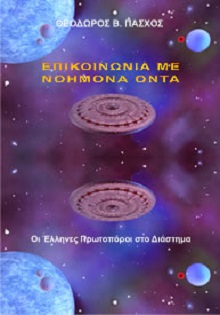
Author: Theodoros Paschos. Pages 320 Two Greek scientists with their technology find solution to the problem of communication with intelligent beings in the universe chasing the future of humanity. Seeking to solving various mysterious phenomena starring in Mission Teams to watch the flying saucers that appear on Earth to Mars and the Moon and to communicate with extraterrestrial beings. In doing so they get involved in adventurous and dangerous stories, but they also discovered the remnants of the technology of Atlantis into the ocean depth. You can preview or get the book from the Website: smashword.com/ |
The Atlanteans and Not the Gods
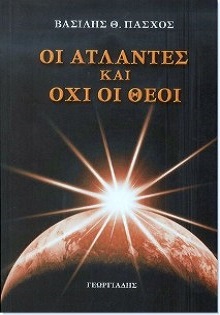
Author: Vassilis Th. Paschos. Pages 350 The author Mr Vassilis Paschos, with this book penetrates research into antiquity and by demystifying legends and traditions, proves the existence of the Atlanteans. For their original residence, the cradle of its culture, their lost country, the author quotes rich material and convincing facts ... |
Atlantes, Not the "Gods"
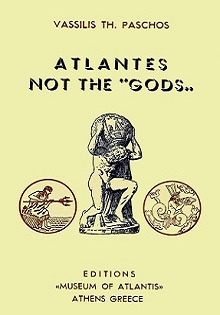
Αuthor: Vassilis Th. Paschos. Pages 80 The new and daring theory of Mr Paschos, is based on elements from Homer, Hesiod, Plato, Proklos, Plutarch, Markellaus and other ancient Greek and Latin writers (their works are mentioned in his book), on Egyptian papyrus, the Gilgames epic poetry of Babylonians, the Bible, the traditions of the people around Mediterranian and Central America and on ancient findings in these areas. You can preview or get the book from the Website: Smasword.com/ |